 Spain Real Estate
  |
 |

|
 |
Kingdom of Spain La Furia Roja |
 |

|
 |
 |
News
about Spain Kingdom
of Spain La Furia Roja
Spain Real Estate
National Holiday: National Day, 12 October (1492); year when Columbus first set foot in the Americas.
Geography
of the Kingdom of Spain
Southwestern Europe, bordering the Bay of Biscay, Mediterranean Sea,
North Atlantic Ocean, and Pyrenees Mountains, southwest of France

Flag of Spain
Flag Description of Spain: three horizontal bands of
red (top), yellow (double width), and red with the national coat of arms
on the hoist side of the yellow band; the coat of arms includes the royal
seal framed by the Pillars of Hercules, which are the two promontories
(Gibraltar and Ceuta) on either side of the eastern end of the Strait of
Gibraltar
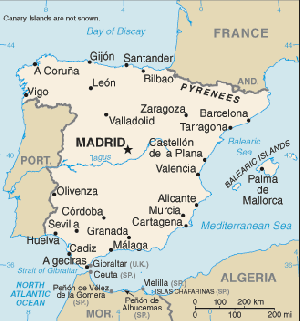
Map of Spain
People
of the Kingdom of Spain
Nationality: Noun--Spaniard(s). Adjective--Spanish.
Ethnic groups: Distinct ethnic groups within Spain include the Basques,
Catalans, and Galicians.
Religion: Predominantly Roman Catholic; Protestant and Islamic faiths also have
a significant presence.
Languages: Spanish (official) 74%, Catalan-Valenciana 17%, Galician 7%, Basque
2%.
HISTORY
of the Kingdom of Spain
The Iberian Peninsula has been settled for millennia. In fact, some of Europe's
most impressive Paleolithic cultural sites are located in Spain, including the
famous caves at Altamira that contain spectacular paintings dating from about
15,000 to 25,000 years ago. The Basques, Europe's oldest surviving group, are
also the first identifiable people of the peninsula.
Beginning in the ninth century BC, Phoenicians, Greeks, Carthaginians, and Celts entered the Iberian Peninsula. The Romans followed in the second century BC and laid the groundwork for Spain's present language, religion, and laws. Although the Visigoths arrived in the fifth century AD, the last Roman strongholds along the southern coast did not fall until the seventh century AD. In 711, North African Moors sailed across the straits, swept into Andalusia, and within a few years, pushed the Visigoths up the peninsula to the Cantabrian Mountains. The Reconquest--efforts to drive out the Moors--lasted until 1492. By 1512, the unification of present-day Spain was complete.
During the 16th century, Spain became the most powerful nation in Europe, due to the immense wealth derived from its presence in the Americas. But a series of long, costly wars and revolts, capped by the defeat by the English of the "Invincible Armada" in 1588, began a steady decline of Spanish power in Europe. Controversy over succession to the throne consumed the country during the 18th century, leading to an occupation by France during the Napoleonic era in the early 1800s and a series of armed conflicts throughout much of the 19th century.
The 19th century saw the revolt and independence of most of Spain's colonies in the Western Hemisphere; three wars over the succession issue; the brief ousting of the monarchy and establishment of the First Republic (1873-74); and, finally, the Spanish-American War (1898), in which Spain lost Cuba, Puerto Rico, and the Philippines to the United States. A period of dictatorial rule (1923-31) ended with the establishment of the Second Republic. It was dominated by increasing political polarization, culminating in the leftist Popular Front electoral victory in 1936. Pressures from all sides, coupled with growing and unchecked violence, led to the outbreak of the Spanish Civil War in July 1936.
Following the victory of his nationalist forces in 1939, General Francisco Franco ruled a nation exhausted politically and economically. Spain was officially neutral during World War II but followed a pro-Axis policy. Therefore, the victorious Allies isolated Spain at the beginning of the postwar period, and the country did not join the United Nations until 1955. In 1959, under an International Monetary Fund stabilization plan, the country began liberalizing trade and capital flows, particularly foreign direct investment.
Despite the success of economic liberalization, Spain remained the most closed economy in Western Europe--judged by the small measure of foreign trade to economic activity--and the pace of reform slackened during the 1960s as the state remained committed to "guiding" the economy. Nevertheless, in the 1960s and 1970s, Spain was transformed into a modern industrial economy with a thriving tourism sector. Its economic expansion led to improved income distribution and helped develop a large middle class. Social changes brought about by economic prosperity and the inflow of new ideas helped set the stage for Spain's transition to democracy during the latter half of the 1970s.
Upon the death of General Franco in November 1975, Franco's personally designated heir Prince Juan Carlos de Borbon y Borbon assumed the titles of king and chief of state. Dissatisfied with the slow pace of post-Franco liberalization, he replaced Franco's last Prime Minister with Adolfo Suarez in July 1976. Suarez entered office promising that elections would be held within one year, and his government moved to enact a series of laws to liberalize the new regime. Spain's first elections since 1936 to the Cortes (Parliament) were held on June 15, 1977. Prime Minister Suarez's Union of the Democratic Center (UCD), a moderate center-right coalition, won 34% of the vote and the largest bloc of seats in the Cortes.
Under Suarez, the new Cortes set about drafting a democratic constitution that was overwhelmingly approved by voters in a national referendum in December 1978.
Spain's powerful world empire of the 16th and 17th centuries ultimately yielded command of the seas to England. Subsequent failure to embrace the mercantile and industrial revolutions caused the country to fall behind Britain, France, and Germany in economic and political power. Spain remained neutral in World Wars I and II but suffered through a devastating civil war (1936-39). A peaceful transition to democracy following the death of dictator Francisco FRANCO in 1975, and rapid economic modernization (Spain joined the EU in 1986) have given Spain one of the most dynamic economies in Europe and made it a global champion of freedom. Continuing challenges include Basque Fatherland and Liberty (ETA) terrorism and relatively high unemployment.
Independence: the Iberian peninsula was characterized by a variety of independent kingdoms prior to the Muslim occupation that began in the early 8th century A.D. and lasted nearly seven centuries; the small Christian redoubts of the north began the reconquest almost immediately, culminating in the seizure of Granada in 1492; this event completed the unification of several kingdoms and is traditionally considered the forging of present-day Spain
Real Estate or Properties for Sale or lease in The Kingdom of Spain
Note: Information gathered from the CIA and The U.S. Department of State
News from The Kingdom of Spain:
Published July 29, 2009
Copyright © 1997-2011 Zamboanga.com All rights reserved.
