
frutas
| MONTH / FRUITS Available | ||||
| January | ||||
| February | ||||
| March | ||||
| April | ||||
| May | ||||
| June | ||||
| July | ||||
| August | ||||
| September | ||||
| October | ||||
| November | ||||
| December |
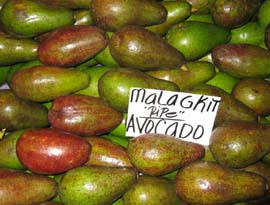
avocado (Persea americana)
The avocado is an important fruit crop for subsistence farmers, small and large-scale producers throughout the tropics. In the lowlands of tropical America, local selections of West Indian avocados dominate regional markets. These local West Indian avocado selections are often of superior fruit quality and adaptation to the climatic and edaphic conditions of the area. Fairchild Tropical Botanic Garden (FTBG) has initiated a 3-year project for the collection of West Indian avocados in lowland Costa Rica, Nicaragua, El Salvador, Guatemala and Panama. Working with local collaborators we have identified superior selections within localized areas of diversity, collected bud wood and established a living collection at the Williams Grove Genetic Resource Center of FTBG in South Florida. Evaluation of fruit and tree characteristics began in 2005.
Avocados should be harvested mature, however, determining the proper time to harvest can be difficult because the fruits change very little. Maturity standards have been determined by weight and time of the year for each cultivar. Homeowners usually harvest the entire crop when a few mature fruits have fallen. This is not the best way to harvest because the flowering of the avocados results in fruits in varying stages of development on the tree at the same time. The best way to know when a fruit is ready to be harvested is the size of the fruit; the largest fruits should be picked first. After harvest, let them ripen at room temperature 75° to 80° F (24° to 27° C). The fruit will ripen within 2-4 days; the skin yields to a gentle squeeze. At this stage, they are ready to eat or may be kept in the refrigerator for several days.
atis (sugar apple)
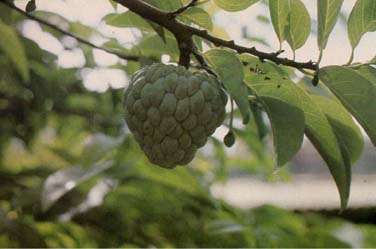
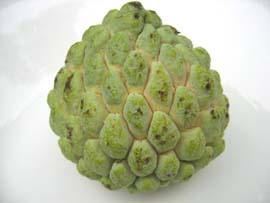
Atis is
just starting to reach the local markets. atis1 Atis (Annona squamosa) or Sugar
Apple is part of the Annonaceae family that includes the more commonly known
cherimoya in the west, guyabano or soursop and surprisingly, the ilang-ilang
tree. It is actually not known where the atis is indigenous to but they grow in
abundance throughout Central and South America. The Spaniards brought seeds to
the Philippines in the early 17th century and the local name hails from the
Aztec “ahate” according to Doreen Fernandez’s book on Philippine fruit. The tree
is relatively small and bears just a few dozen fruit when left to its own
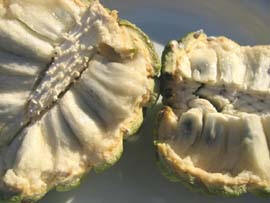
devices. But the fruit can be heaven, hundreds of seeds inside are coated with a
soft sugary pulp or meat that tastes like a super sweet custard. The seeds can
be a pain in the neck but if you enter an atis zen mode prior to breaking one
open, you learn to work the seeds to get at the wonderful pulp.
Atis does not travel very well and ripens atis2rapidly so it isn’t an export
type fruit. When there is atis, there is a lot of atis. Last weekend I got some
of the first ones to reach the market and paid a whopping PHP120 a kilo. But
after 1-2 days left on the dining table they were ripe and super sweet. For some
reason, atis tastes much better when served nice and cold. Place in the
refrigerator at least 3-4 hours before eating. I have only eaten this fruit as
is, never cooked or part of another dish. Atis seeds, by the way, are poisonous
and you shouldn’t swallow them. Worse, if they are dried and powdered, the
powder can be used as a poison for catching fish, or as insecticides or my best
find in terms of use: to remove lice from your hair. But be careful as the
powder can cause blindness!
banana (saging)
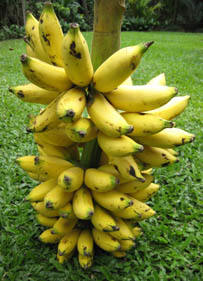 recimo
 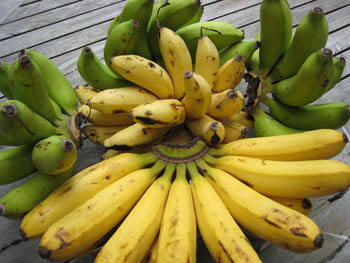 pengka
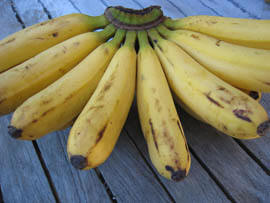 lacatan variety
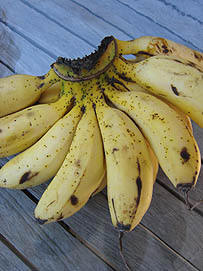 bungulan (latundan) variety
1. saba (frying)
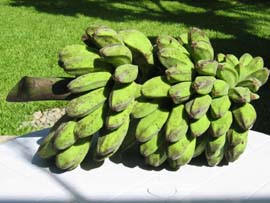
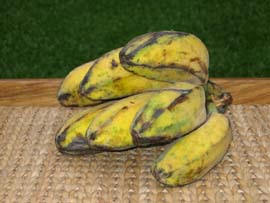
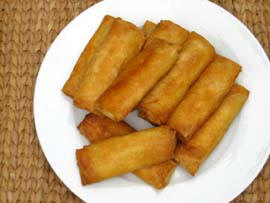 turon
turon
2. san pedro (plantain)
3.
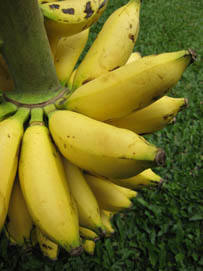 senorita (short) variety
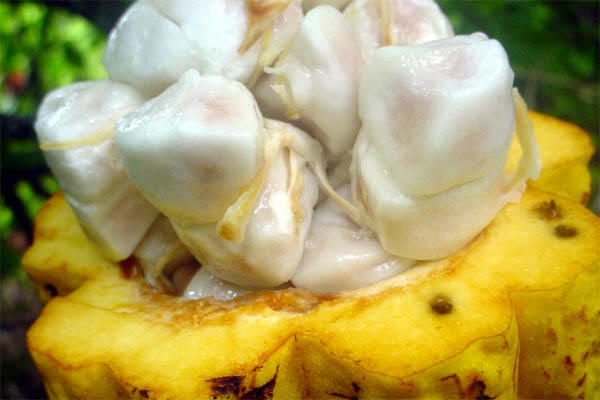
cacao
camias (belimbing)


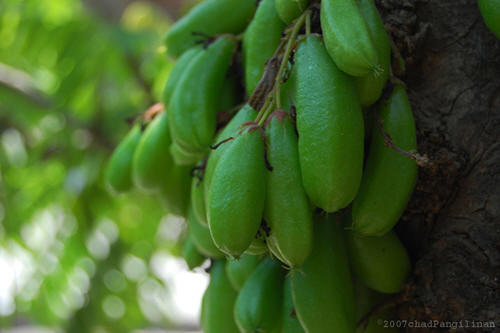
Camias (Averrhoa Bilimbi), a tropical fruit
native to Malaysia and Indonesia, belongs to the family Oxalidaceae. The fruit
is important locally for its many medicinal uses and as an ingredient in Malay
cooking.
Origin and distribution
Camias (Averrhoa Bilimbi) is native to Malaysia and Indonesia. It belongs to the
same family as the sweeter star fruit, which Malays call belimbing manis, to
distinguish it from camias which they call belimbing asam for its sour taste.
The Averrhoa bilimbi gets its name from two words: Averrhoa, from Averroes (b.
1126 - d. 1198), a famous Moorish Physician; and bilimbi from the Malay word "belimbing".
In 1793, the fruit was introduced to Jamaica from the island of Timor and spread
to South America soon after. Today, bilimbi is found as a cultivated or
semi-wild crop throughout the tropics: in Ceylon, Burma, India, Thailand,
Australia, South America, the lowlands of Central America and occasionally in
Southern Florida, USA.
Description
Camias trees are evergreen and measure between 6 to 9 m high. The leaves tend to
crowd towards the ends of branches, occurring in pairs of 7 to 19 leaflets which
ovate, measuring between 5 to 12 cm long. The branches are very few and upright
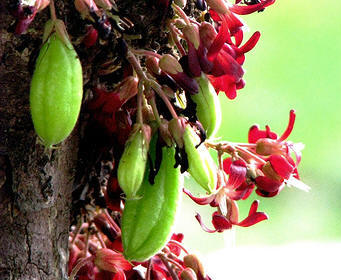
while the flowers are small with reddish-purple or crimson free petals that
measure 10 to 22 mm long. Flowers are auxiliary or cauliflorous, appearing
directly on the branches and trunk. They are produced all year round. When the
plants are in bloom, the flowers attract a lot of small bees and insects in the
bright morning light. The camias fruits are berries, yellowish-green, lobed
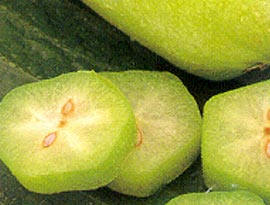
slightly and measure up to 10 cm long. The skin is thin and smooth, enclosing a
soft and juicy flesh which is sour. Seeds are few, flat and occur at the centre
of the fruit. The plants grow well in a seasonal humid climate and do not
tolerate flooding and salinity.
camias (redondo)
Roundish, yellowish when ripe, fruit, bunched up to a stem, a little bitter taste....
calamansi / calamondin scientifically referred to as Citrofortunella mitis (Citrus reticulata x Fortunella sp), i.e. a hybrid of a Mandarin orange and the Kumquat
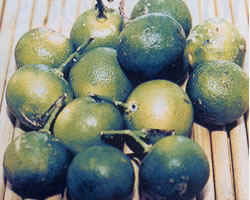
Very popular as a souring agent is the kalamansi. This little
green lime, which is indigenous to the country, plays a giant role in Philippine
cuisine. It is squeezed into juice and punches, into hot tea, over pansit, into
arroz caldo, over charcoal-grilled fish, over kinilaw, and is an important
ingredient in innumerable dipping sauces (sawsawan). When used as a sawsawan,
kalamansi is often mixed with patis (fish sauce) or soy sauce for that
indescribable sour-salty taste.
Don't throw away those kalamansi peels. They effectively wash away the lingering
smell of seafood after picking on them with the hands. Or dip them into
dishwashing solutions to produce a lemony fragrance. Enterprising Filipinos have
come up with bottled pure kalamansi extract flavored with honey. It is a welcome
idea as it spares us the task of having to squeeze each tiny fruit of its juice.
Mixed with ice cold water it makes a refreshing drink. One restaurant even came
up with a dessert called calamansi tart, in which this native fruit takes the
place of lemon as the main flavoring.
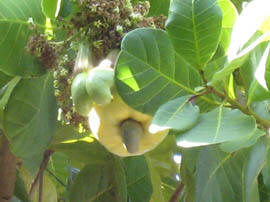
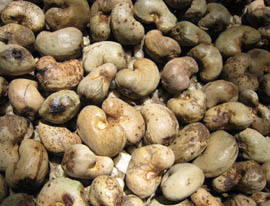
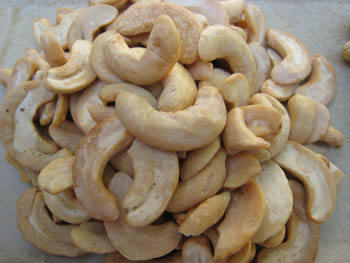
casuy - cashew fruit & nut

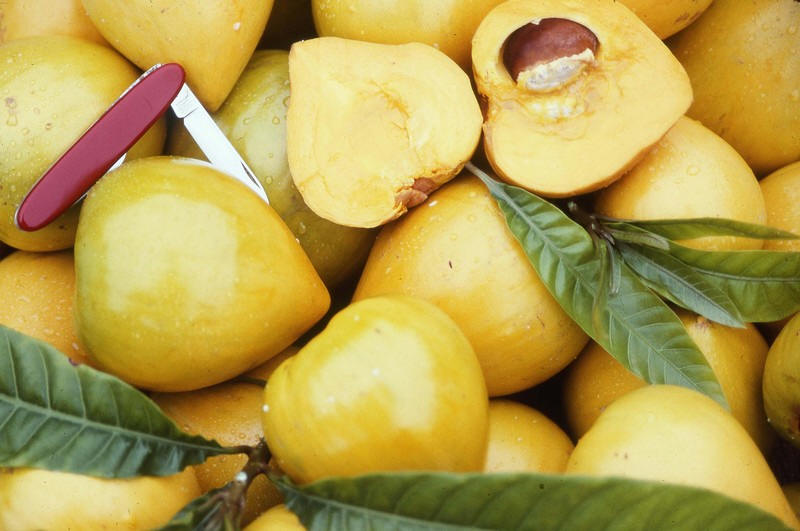
chesa - tiessa, canistel (Pouteria campechiana)
The canistel is native to the Yucatan Peninsula, where it was cultivated from ancient times by native people. A member of the Sapotaceae family, the canistel is highly adaptable in Florida where it is grown in some home gardens. The tree is easy to grow with minimal care because it is quite wind resistant and tolerates sandy or limestone soils. Fairchild Tropical Botanic Garden has been working in significant research conducted on the superior selections for the past 15 years within the genetic bank located at Williams Grove Genetic Facility.
Canistel has similar characteristics to cooked pumpkin. It is delicious when mixed with milk products. The yellow flesh is relatively firm and mealy with a few fibers. The fruit matures from November through March. Canistel can be eaten fresh or used in pies, milkshakes, pudding and bread. The fruit are picked when mature (yellow-color) and can be stored at room temperature for 3 to 10 days. If you wish to store the flesh you can freeze it for up to 6 months. Before freezing, mix the flesh with sugar. Canistel are rich in vitamin C, calcium, minerals and low in fat.


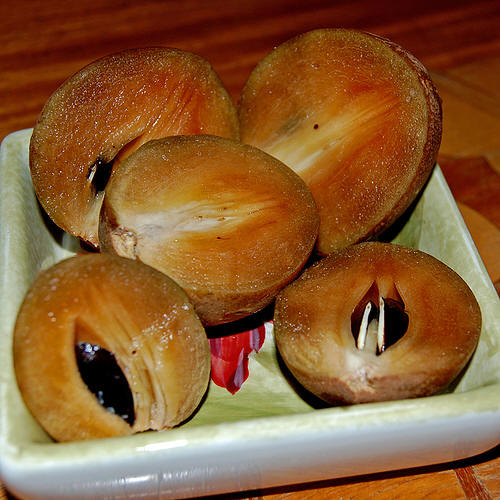
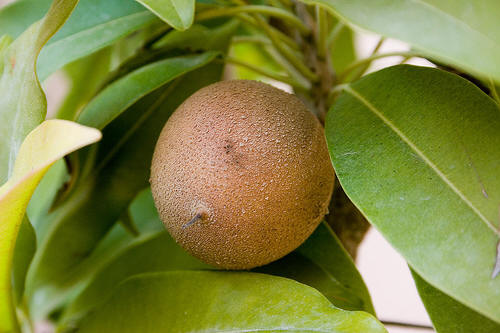
chico - Mamey sapote, sapodilla (Pouteria sapota)
The mamey sapote (Pouteria sapota) is native to Mexico and Central American lowlands. It grows well throughout the Caribbean islands and the lowlands of South America, Central America, and in the West Indies--including the Dominican Republic, Puerto Rico, and Cuba where it is planted as a dooryard fruit and cultivated commercially for the local market. In South Florida the mamey sapote is well adapted. We have 40 different mamey sapote cultivars in our genetic collection located at Williams Grove.
It takes from 13 to 24 months from flowering to fruit maturity. This large, long fruit has coarse, brown, leathery skin and yields to a gentle squeeze when ripe. The flesh is salmon or red colored and has a sweet taste with a texture similar to custard. Mamey sapote has a very distinctive flavor which blends well with milk, other fruits, and is especially tasty in smoothies.


coconut
coconut (macapuno)
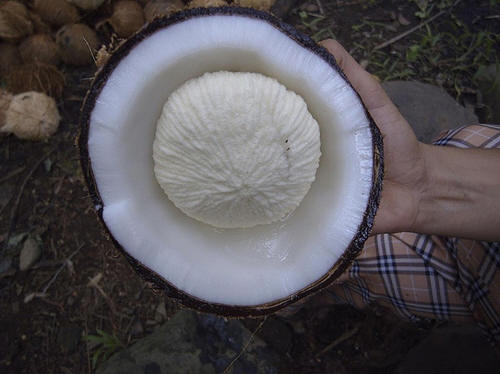
The macapuno
is a mutant of the coconut. Until I had to write this piece, I thought that the
macapuno fruit is just an abnormal outgrowth of the regular coconut tree as I
had learned as a child. Not anymore, the Philippine Coconut Authority corrected
me. The Authority has developed macapuno trees that yield 80 per cent macapuno
fruits. The trees grow in abundance in Albay where the Authority's research
center is.
The macapuno fruit looks like the regular niyog except that it is bigger.
Farmers have a way of knocking on the nut to determine if they have macapuno or
niyog. The macapuno meat is as thick as the niyog but softer, making it easy to
grate. Macapuno is cooked with sugar, sometimes with dayap for flavor, and
served as a dessert. Local ice cream makers also have macapuno flavors.
dalandan
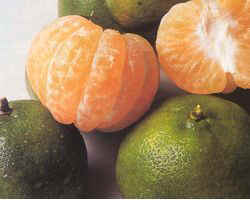
The local orange. Or what's left of it. In the '60s, we had a variety of local oranges that were big, juicy and sweet. The ladu variety, which was common then, had a deep green and orange peeling that had the shape of, but was much bigger than, the ponkan. A really special variety which delighted many people was the suwikom variety, which had very firm but very sweet pulp bits. There were many varieties that grew in Batangas. Too bad a pestilence killed these oranges trees in the late '60s. Now we're left with these small fruits that are often too sour for eating, but are very juicy and perfect for making into juice.
datiles (Manzanitas)
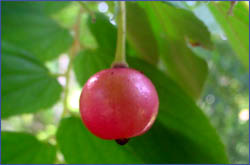
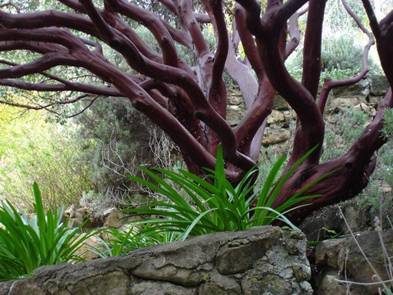
also called datiles (from dates):
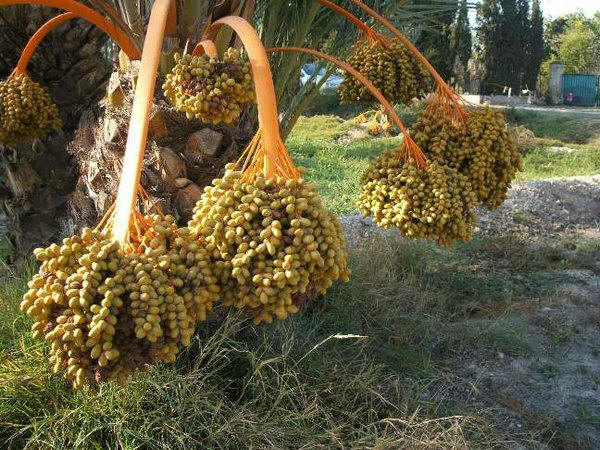 datiles1.jpg
dayap (lime)
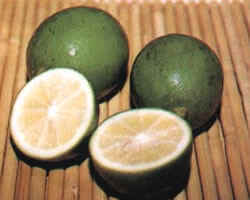
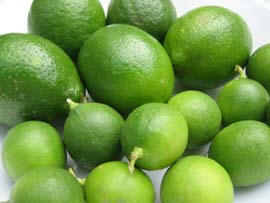
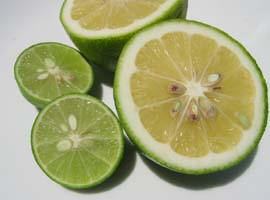
The local lemon or lime. Among traditional cooks it is the critical flavoring
for leche flan and macapuno because it keeps the rich desserts from being too
sweet. I put a slice of dayap into my glass of Coke and noted that my soda had a
fuller, heartier taste. Dayap is also said to be the equivalent of key lime,
which grows in Florida and is often made into pies. I met an elderly woman in
Bulacan who said that she sculpts the dayap rind before pickling the fruits when
these are in season. I should see that work of art.
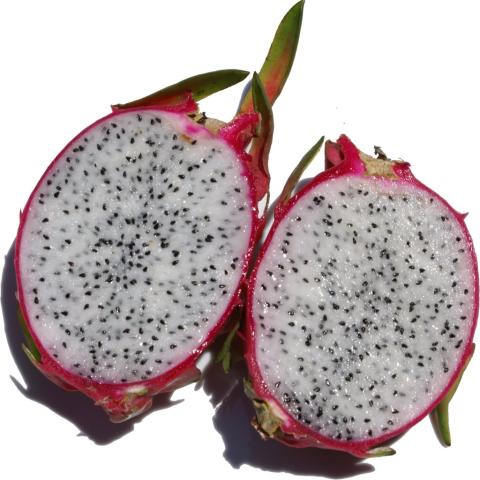
dragon fruit
duhat
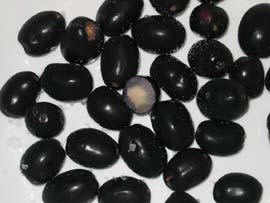
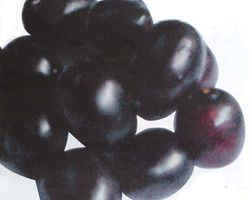
Don't ignore these purple berries this summer when they're
aplenty. And if no one has yet shown you how to eat duhat properly, read on. Put
ripe berries in a deep bowl, wash them in running water then drain. Sprinkle
with salt, cover the bowl with a plate and shake the bowl vigorously for about
30 seconds. Remove the plate cover. Note that you've practically made a mess in
the bowl but no matter. Place a berry one at a time on your tongue and bite on
the fruit tenderly. Utmost pleasure, really. But beware - the color stains
clothes so eat carefully.
One of the first signs of summer is the arrival of duhat in the local markets. duhat1 Today I could not resist a huge basket filled to the brim with large duhats. Also known as Java Plum (Syzygium cumini), ripe duhat are oblong or round in shape, about the size of a medium to large olive, and possess a purple to black (when ripe) thin skin and a white pulp surrounding a single seed. The fruit is generally described as “aphud” or astringent and can be distasteful to quite sweet. “Aphud” is a uniquely Filipino description, as the fruit isn’t just astringent, it reacts with your tongue and mouth lining in an almost numbing manner, albeit fleeting. It is a textural experience. Hard to describe and I haven’t done it properly…
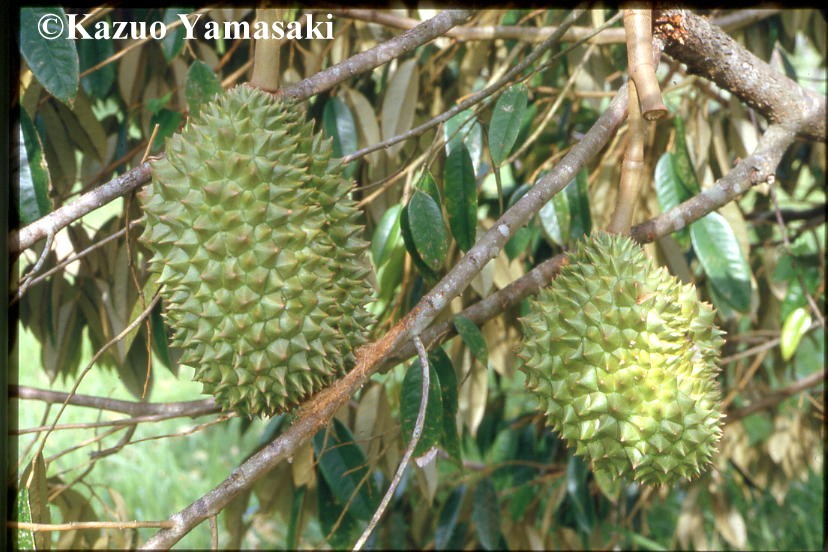
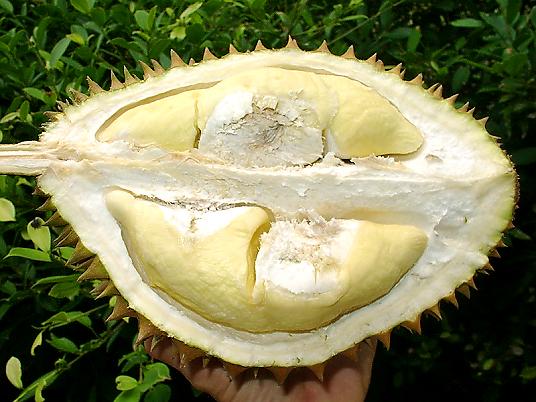
durian
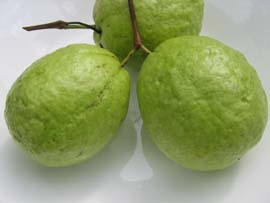
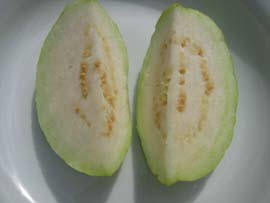
guava (guyaba)

grapefruit - ruby
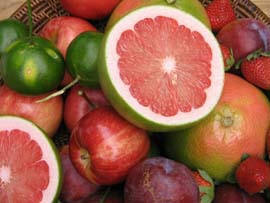
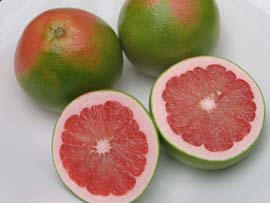
Grapefruit grown in Davao? Yup. Here is the scoop on the first crop of Ruby Red Grapefruits grown in Davao by Nenita farms that I spotted and purchased this morning. Grapefruits (Citrus paradisi) are related to pomelos or shaddock, therefore they logically should thrive where pomelos do well… Grapefruits thrived in the Caribbean islands and were introduced to Florida in the 1820s. They eventually caught on and became a major crop for the citrus growers in that state. These locally grown grapefruits look terrific… a very nice sheen to an unblemished greenish peel with splotches of pink and shades of yellow. One of the largest fruits in the citrus family, the grapefruit is high in vitamin C and relatively low in calories, great for those on diets. The grapefruit in this photo is part of a still life arrangement of fruits that I arranged for a photo shoot.
guyabano
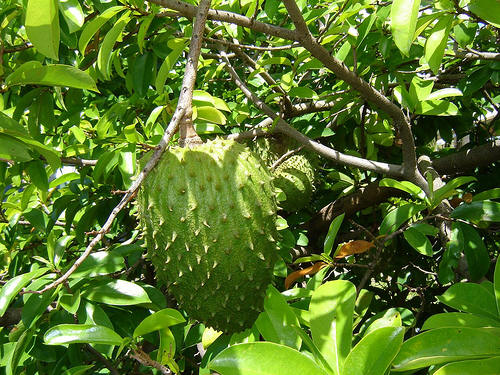
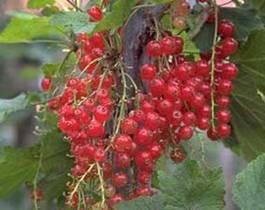
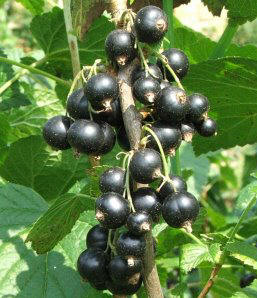
grosella - camias redondo (yellow)
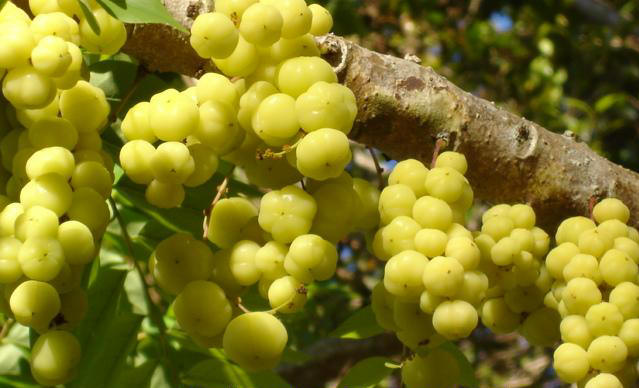
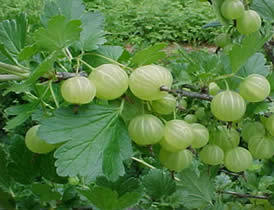

kamanse - kamansi, seeded breadfruit
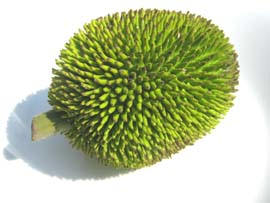
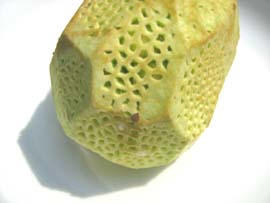
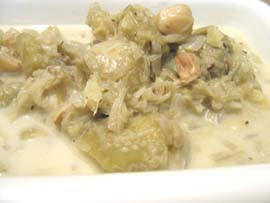
Kamansi
or Seeded Breadfruit kam1(Artocarpus camansi) is very closely related to but not
the same as Rimas or Breadfruit (Artocarpus altilis). I didn’t know that so
maybe some of you didn’t either. Kamansi has sharper points on its skin, more
like a jackfruit (another close relative) while Rimas has a flatter outer skin.
Kamansi has soft seeds and Rimas has no seeds. I spied these unusual little
Kamansi from an organic vegetable seller that I frequent and decided they looked
too interesting to pass up. I brought home three small Kamansi and hoped that
the cook had heard of these before… she had, good Boholana that she is, Kamansi
and Rimas grew in abundance in her native Bohol. Kamansi are believed to be
native to Papua New Guinea and possibly Indonesia and the Philippines.
When I was still a single digit (years, not fingers) kid kam2I used to go with
my mom to her ancestral home in the boonies of Bohol (4+ hours in a jeep to get
there from Tagbilaran on a dusty coastal road but on a map it is just 80
kilometers!) and once ensconced there, we had to visit all of our relatives who
then proceeded to whip out their finest snack of fried breadfruit locally called
Kolo (not Rimas) with latik (a sugary sweet dip). As yummy as that was, having
it 7 times in a row as we progressed down the main street at a languid late
afternoon pace was enough to make me want to scream at the top of my lungs that
breadfruit in fact gave me seizures that resulted in lesions that were
contagious and unsightly… Then the next day we would have to do the other side
of the street! Needless to say, I never ate breadfruit again for another 20 or
so years…
Back at home, the cook peeled the skin of the small Kamansi kam3(which she felt
were picked too young by the way) to expose the whitish pulp and seeds. Boiled
in a little water to cook the pulp, she added coconut milk, onions and ginger.
Served as a vegetable, it was a bit like unripe jackfruit but softer and
mushier. I didn’t particularly like it but it wasn’t bad. Maybe I just haven’t
gotten over my breadfruit phobia just yet. At PHP50 for 3 pieces, this makes a
very economical “vegetable” dish out of the Kamansi fruit. Sources: Uncommon
Fruits & Vegetables by Elizabeth Schneider; Oxford Companion to Food, Alan
Davidson.
lanzones (langsat)
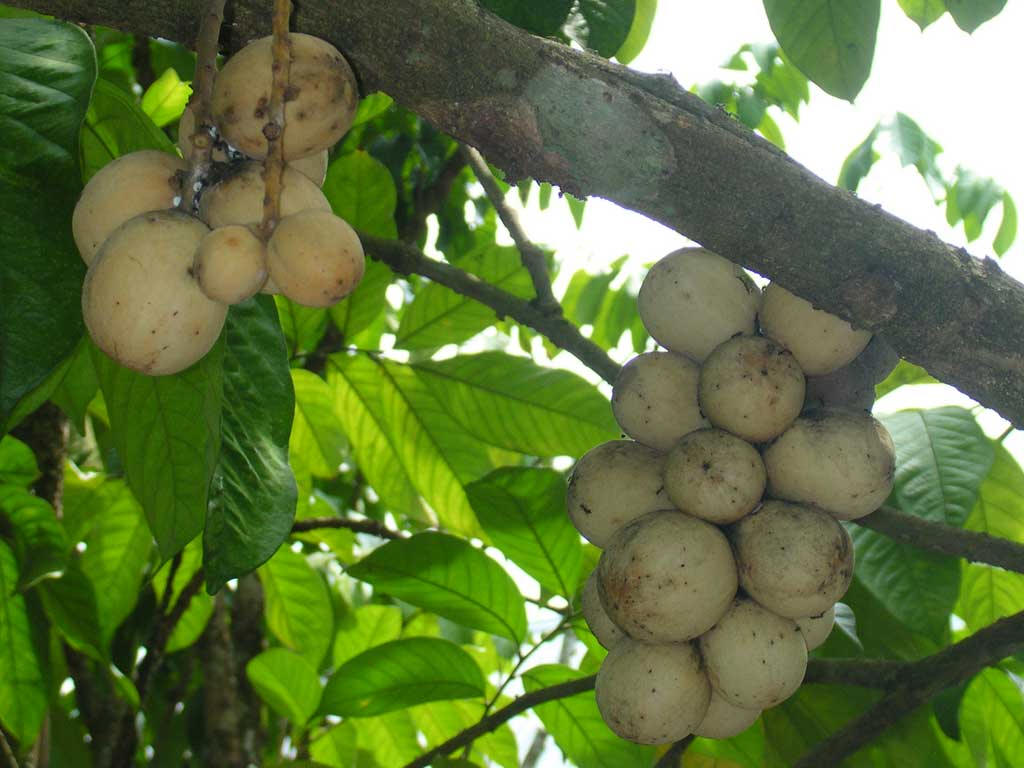
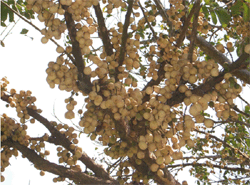
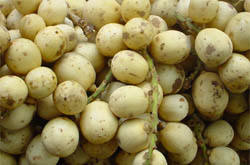
Lanzones
(Lansium domesticum) are native to Western Malaysia and have alanz1become a
relatively popular fruit in the Philippines and Indonesia. Known as langsat in
Malay, these fruits grow wild and in cultivated plantations in Southeast Asia.
Most common in Borneo, Java and Mindanao, these tropical fruits ripen and spoil
relatively quickly and are rarely seen in the West. In the Philippines, over 75
% of all lanzones is grown in Sulu province, a revelation for me as I always
thought Laguna and the Southern Tagalog region was the primary area of
cultivation outside of Camiguin in Misamis Oriental – hmm. Camiguin is known for
its annual lanzones festival and their fruit is supposed to be unusually sweet
and delicious. In Luzon, the lanzones season has just started and will last
another 5-6 weeks at most. In the South, Mindanao has lanzones from January to
April.
An oval khaki colored fruit, lanzones has several alanz2segments within with
white, translucent and juicy flesh. They kind of “pop” in your mouth and can
range from unbearably sour to incredibly sweet. Often there is one seed larger
than the rest. The seeds are wickedly bitter and highly distasteful – biting
into too many of them is a real turn-off. There is a sap to the skin that is
extremely sticky and fairly gross on the tongue – kind of like spreading a
faster drying Elmer’s glue on your tongue. When just ripe, this is a tropical
fruit par excellence. It has flavor, juiciness, sweetness and a uniqueness that
is not found in western fruits. Apparently, bats have figured this out and they
munch on the ripening fruit with a vengeance. In Indonesia, they wrap pungent
bundles of shrimp paste and hang them on the trees to distract or repel the
bats; in Paete, Laguna they apparently hang kerosene lamps on the trees to do
the same task. The resulting view of hundreds of hanging kerosene lamps on a
hillside is said to be spectacular.
lemoncito


mabolo (kamagong)
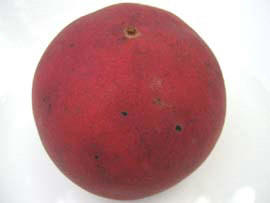
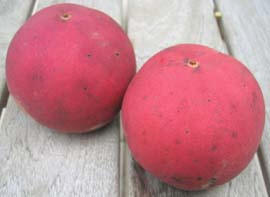
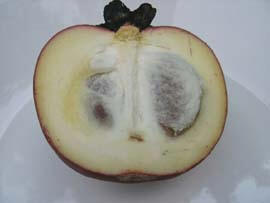
Mabolo or
Kamagong is indigenous to the Philippine archipelago. amab4So local, in fact,
that it doesn’t really have an English name, though some literature has referred
to it as a “velvet apple” or in India, as a “peach bloom.” Mabolo (Diospyros
blancoi A. DC.) is a member of the Edenaceae family and thrives in low and
medium level rain forests in the Philippines. Today it is often planted by
roadsides for their shade or as an ornamental plant in some gardens. It is a
handsome tree with lush foliage. The fruit has a stunning red velvety feel or
fuzz that is brilliant to look at; however, it does come with a pungent aroma
that many might find off-putting. I had never eaten or come close to a Mabolo
before so when I spotted dozens of brilliant red fruit at a Batangas roadside
stand last week I thought I should buy some and learn more about this fruit.
I was simply unprepared for the smell… purchased on the same trip as the
Jackfruit or Langka of amab2earlier posts, this fruit let off a “ripe cheese”
aroma that would make some a little car sick. It seems the smell emanates from
the skin and not the pulp of the fruit. An almost perfect sphere, the red
velvety skin is similar to that of the fuzzy skin on a firm peach. Apparently
Mabolo can also come in a yellowish brown variety though the pulp is similar.
Inside is a cream colored pulp with a consistency more akin to a sandy or
cottony apple but with a flavor that is reminiscent of bananas and apples mixed
together. It can have a few seeds or occasionally it is seedless. I was not a
convert; I don’t have to give this another try for another 40 years…
The fruit has been introduced to Indonesia and Malaysia and in the late 1800’s
made its way to India. amab3Seeds were also sent to the U.S. and the plant has
been successfully raised in Florida, Hawaii and other warm areas though it was
never raised commercially. Though I have very little knowledge and experience
with this fruit, I gather it is yet another of those backyard fruits that others
may have stronger childhood memories of. To serve, peel the fruit and stick it
in the fridge for 3-4 hours. The smell will have mostly disappeared (as it is in
the skin) and you can enjoy the chilled pulp. Most people who consume this fruit
do so when it has ripened and it’s flesh is cut into wedges or scooped out with
a small spoon. I am curious to see if many Marketmanila readers are fond of this
fruit…
macopa (tambis)
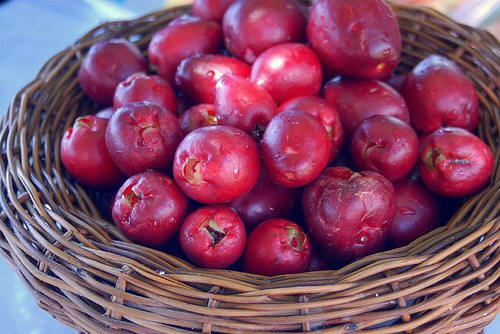
mango
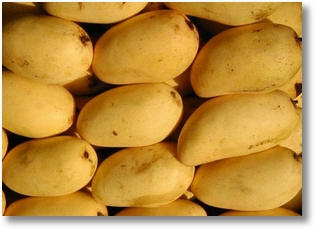
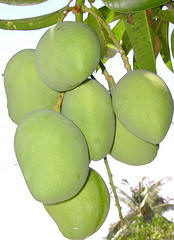
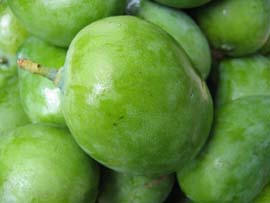
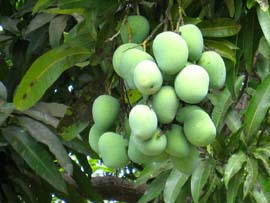 indian mango
Indian Mango is how I have always known these smaller, pudgier and imang1less intensely flavored variety of mango. It is a strange name however, as all mangoes are ultimately believed to have originated in or around India and to select this common name is a bit odd given that there are hundreds if not thousands of species of mangoes all related to the original Indian Mango. Nevertheless, Indian (dot not feather) mangoes are nearing their absolute summer peak right now and they are falling off of trees in the Southern Tagalog area. A favorite summer fruit from my childhood, I could eat half a dozen of these mangoes (green) with some rock salt or shrimp paste (bagoong) and I also like them semi-ripe. Now is the time to buy several kilos at the markets and enjoy this fleeting summer fruit.
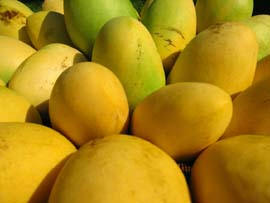
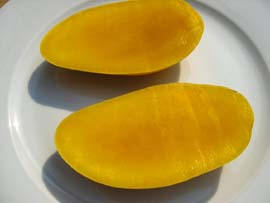 manga carabao (carabao mango)
I think Cebu has simply the best mangoes in the world. So there. Teehee. amang1I was born in Cebu and I probably am biased but it’s my blog so I can write whatever I want! Mangoes (Mangifera indica) probably originated in India, have been cultivated for over 4000 years, and are one of the most widely consumed fruits on the planet today. In fact, Desmond Tate, in his book on tropical fruits, asserts that more mangoes are consumed on the planet every year than apples or bananas. That’s where a billion folks in India make their mark. There are somewhere between 40 and 60 species of mangoes growing from India to Papua New Guinea and about half of these species bear edible fruit. Mangoes like a slight change in seasons or temperature which helps them flower and thus they thrive more a little North of the actual equator (Philippines better than Indonesia, for example…). I could eat a mango every day and if I had to choose just one fruit to consume, it would definitely be a mango.
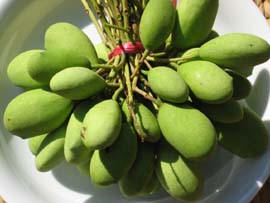 Paho. These small tart mangoes are not
underdeveloped or baby large sweet mangoes but rather a species of its own
(Mangifera altissima)
Paho. These small tart mangoes are not
underdeveloped or baby large sweet mangoes but rather a species of its own
(Mangifera altissima)
mangosteen

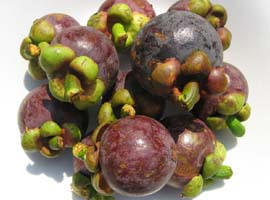
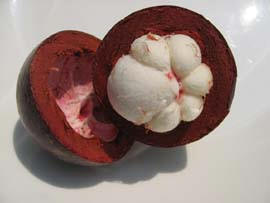
marang
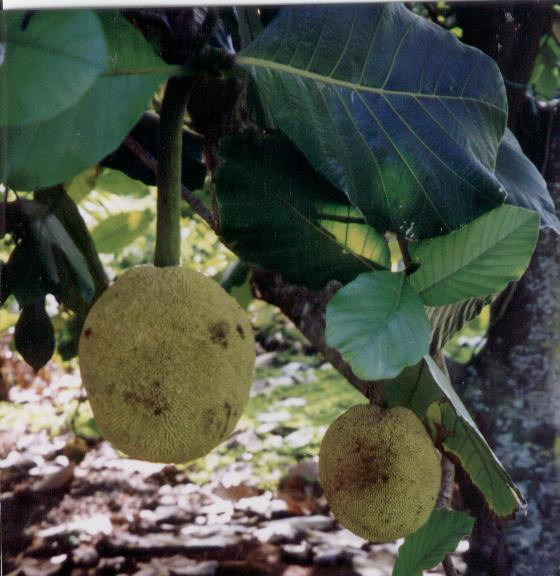
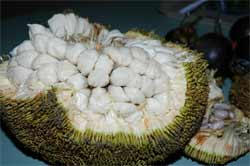
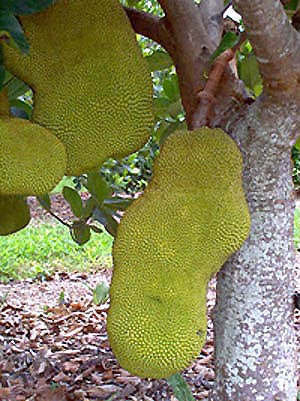
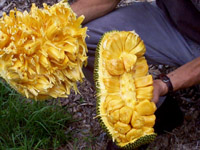
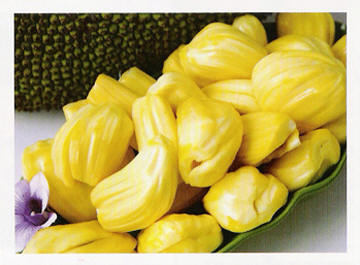
nangka - Jack fruit (Artocarpus heterophyllus)
The Asian tropics have long fascinated western fruit enthusiasts. Where else can you be seduced by the sultry tastes and aromas of durian, mangosteen, rambutan and pulasan? Or, of course, Artocarpus heterophyllus, the fabled jackfruit? This most unusual fruit is a member of the mulberry family, although its outward appearance would not suggest the relationship. The fruit can weigh up to 30 or 40 pounds, with an unusual, spiky green skin. Inside there are a hundred or more large, starchy seeds surrounded by a sweet and aromatic flesh, all attached to a central core. The aroma of the ripening fruit is extremely sweet, with a distinctive flavor reminiscent of bananas and 'Juicy Fruit' gum.
The origin of jackfruit is probably India. David Fairchild collected a variety in Ceylon which was then planted on his property in Coconut Grove. Jackfruit is also called jak-fruit, jak, jaca, in Malaysia and the Philippines, nangka; in Thailand, khanun; in Cambodia, khnor; in Laos, mak mi or may mi; in Vietnam, mit.
Although the jackfruit was introduced to Florida and tropical America over a century ago, it never attained widespread acceptance. This was probably due to its unusual appearance, unique aroma and lack of local familiarity with its uses. Also, because it was difficult to graft, there was little improvement in jackfruit and most of the trees in this hemisphere were of inferior quality.
Fairchild Tropical Botanic Garden has collected, planted at the Williams Grove Genetic Facility and nurtured more than 30 jackfruit cultivars from India, Thailand, the Philippines, Indonesia and Australia. We are now fruiting these treasures. We are also revising our cultural practices, based on what we have learned over the past ten years of intensive study.

orange
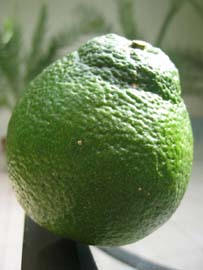 satsuma orange
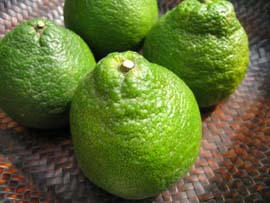
These wonderful deep
green oranges caught my eye at the markets the other day. satsuma1Oranges
usually mean the winter is right around the corner and with the slight chill in
the Manila air…it must be orange season. Dalandans, calamansi, dayap and other
citrus plans are all fruiting in abundance… According to the Purdue University
website, this wonderful orange (citrus reticulata var. Satsuma) is a member of
the Mandarin family that is characterized by an easy-to-peel skin. The fruit
itself can have a deep and intense flavor though quite a few fruit do tend to be
“lemons” in that they can be dry and tasteless. These particular Satsumas were
grown in Nueva Vizcaya, the avowed citrus capital of the country…
I used the fruit in a locally grown fennel and orange salad. satsuma2 Just cut
the fennel into very thin slices (I use a mandoline) then put orange segments
(without the pulp) and some orange juice from the fruit, olive oil salt and
pepper. This is an extremely easy and delicious salad to make. I found that the
Satsumas also looked great as part of a fruit basket. I purchased four fruit at
the market and they came out to about PHP80 or less than US 40 cents each!
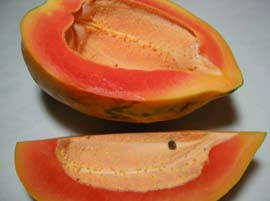
papaya
pomelo
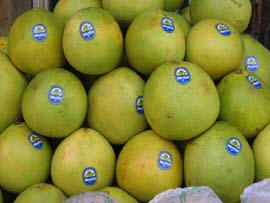
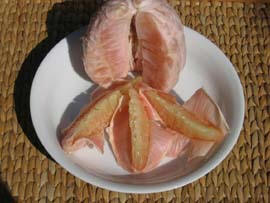
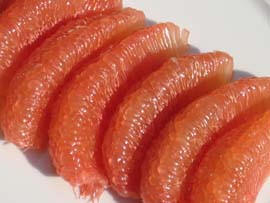
Suha or Pomelo (Citrus grandis) is the largest citrus fruit of all with fruits weighing up to 3.0 kilos. suha1According to the Oxford Companion to Food authored by Alan Davidson, the Pomelo is an ancestor of the grapefruit and is believed to have originated in the Malay Peninsula or Western Indonesia. From there it migrated westwards and now thrives in several tropical climates around the world. Pomelo is believed to be derived from the Malay word pumpulmas which evolved into the Dutch pompelmoes and truncated by the English into pummelo or pomelo. Sometimes called Shaddock for the sea captain who brought them from Polynesia to the West Indies in the mid-1600’s. Several varieties are now being grown and the pomelos from one country to the other vary tremendously. Indonesia has huge fruits that sometimes have a milder flavor. Thailand likewise has large juicy fruit that is either yellowish or light pink in color. The Philippines tends to have smaller fruit and while I would say at best, erratic quality, the good pomelos here are really good. I like the smaller fruit as long as the texture, color and taste are top notch.
http://www.marketmanila.com/archives/suha-pomelo-shaddock
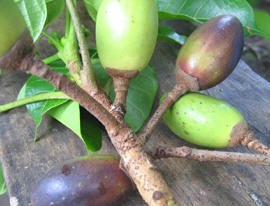
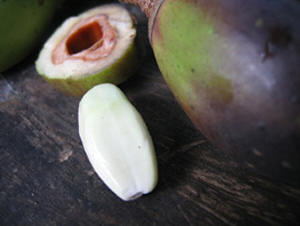
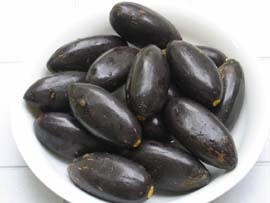
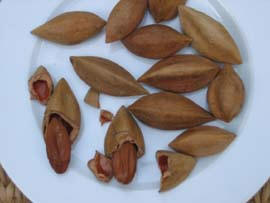
pili fruit & nut
rambutan
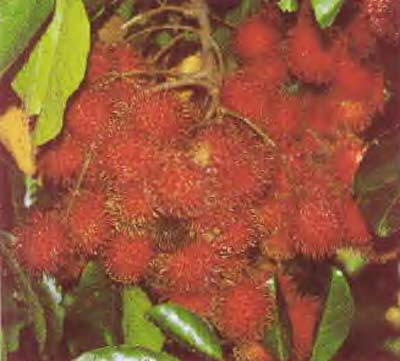
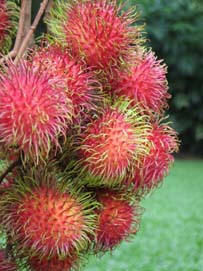
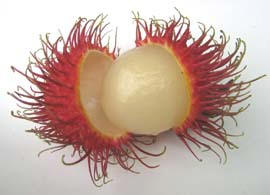
Rambutan
season has started!!! The first harvests of this aram1wonderful fruit are
starting to hit the local markets. Last Saturday I purchased a very fresh bunch
of rambutan grown in Batangas or Laguna at a still pricey PHP80 a kilo at a
local market. Rambutan (Nephelium lappaceum) is believed to be native to
Malaysia and Indonesia (hence its name being derived from the Malay word rambut
or hair) and thrives in the Philippines in Mindanao, Palawan, Mindoro and more
recently in Laguna and Batangas. Although the season is usually from August to
October, as with most summer fruits this year, rambutan seems to be ripening a
little earlier following a really hot summer and a nice rainy start to the wet
season. A relative of the lychee and longan, rambutan is distinguished by a
spectacular peel that appears to have tons of “hair” and is either bright red,
yellow or a mixture of both with tinges of green as well.
Fresh rambutans look alive and sprightly, almost creature like. aram2The fruit I
bought on Saturday were picked within the past 24 hours. Still on their woody
stems, the bunches of fruit looked absolutely wonderful. Though they keep well
in a refrigerator for several days, the hairs wilt and dry up and the fruit
looks a lot less appetizing from the outside. Because of this, the fruit is not
typically exported outside of Southeast Asia and it is very rare that you see it
in the West. Probably why it hasn’t acquired an English name either…hmm…what
would some of the likely options be: hairy red fruit, spiky fruit, bad hair day
fruit? Inside the “hairy” skin is a pearly white and translucent fruit/pulp that
can be incredibly sweet or sweet/sour. The meat is attached to an inedible seed,
though I read that in Thailand they have perfected the art of extracting just
the yummy pulp (removing the seed, then they sell these already peeled and
de-seeded). For the Thai royal family, kitchen staff used to remove the seeds
and return the pulp to the skins to make life easier for the pampered
royals…nice…I wish someone did that for me here…
While I have only eaten this fruit fresh, it seems other aram3countries have
started to can it and its juice for local and export consumption. Others also
have started to toy with the fruit in cooked desserts… Rambutan also comes in a
surprisingly yellow variety… I saw some a couple of years ago and they were
stunning. Apparently some growers in Los Banos have started to raise the all
yellow variety. How would I rate this first bunch of rambutan fruit for the
season? About a 8 out of 10. They were extremely fresh, sweetish sour (I have
had sweeter) and juicy – a good sign that as the season peaks the quality should
get much better. Sources: Desmond Tate’s Tropical Fruits and Doreen Fernandez’s
Fruits of the Philippines.
santol
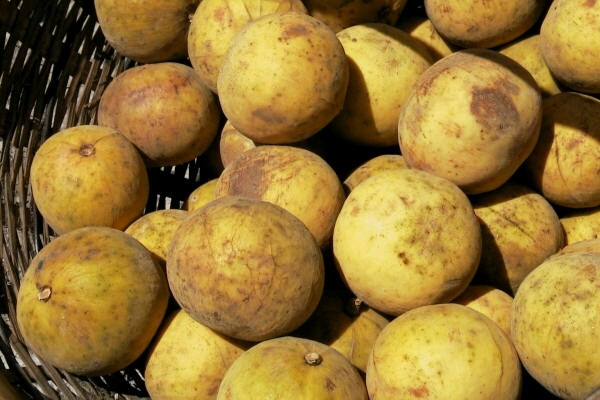
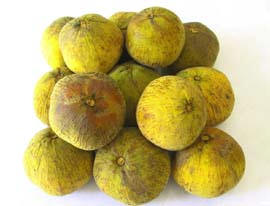

Santol (Sandoricum koetjape) is an extremely familiar fruit to most Filipinos and for me, another top hit on my list of local summer fruits. The tree is believed to have originated in the Indochina region, specifically in the Cambodia or the Southern Laos area, according to the Purdue san1University website on tropical fruits. Our name, santol, is very close to the Malay term for the fruit – sentul. The tree has since spread to most of Southeast Asia and also thrives in India. It is probably the only tree in the Meliaceae family that has edible fruit. The outer pulp of the fruit can be extremely unpalatable and astringent when the fruit is unripe but miraculously transforms itself into a sweet and flavorful ripe specimen. I love santol. I spent a few years of my childhood in Quezon City and in our front yard we had a humongous “Bangkok” santol tree that must have been a good 40 feet tall, or so it seemed to a short toddler… There are essentially two local varieties of santol, the “native” one with smaller fruits and the imported “Bangkok” hybrid that was first introduced over 50 years ago.
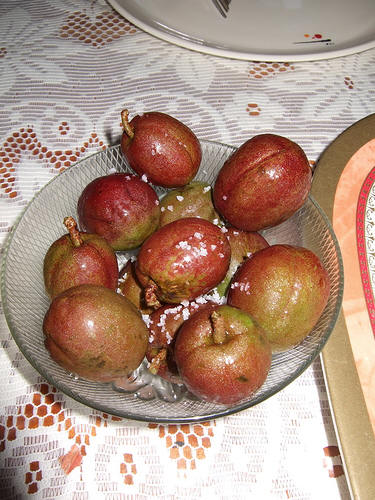
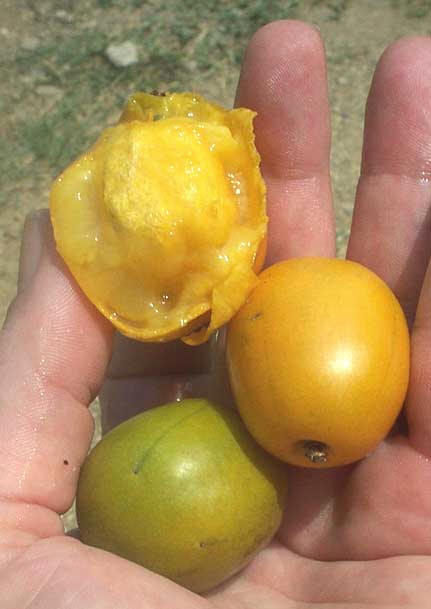
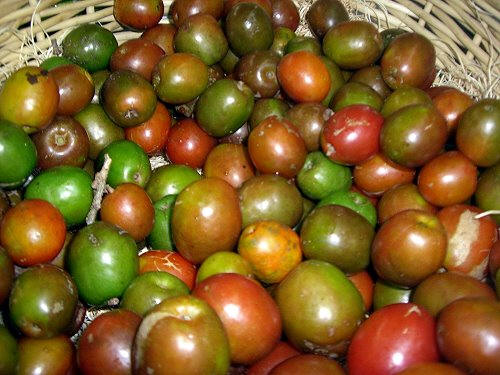
Ciruela is available only in June and is sometimes known in English as Yellow Mombin or June Plum. The Spanish name ciruela means "plum," and these tree fruits look and taste a lot like northern plums. After growing on leafless tree limbs for months, the fruits ripen at the end of the dry season, in June or so.
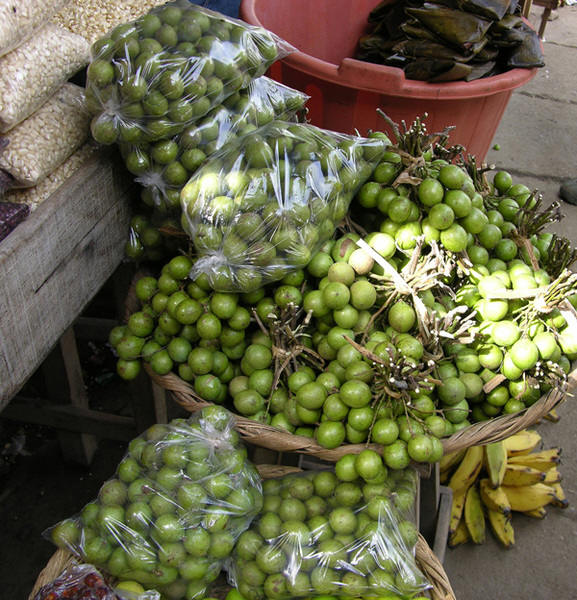
spanish lime (Melicoccus bijugatus )
The Spanish lime is a Tropical American fruit with potential for plantation and estate agriculture in Florida and the Americas. The fruit is classified as a drupe, ranging in size from 12 to 30 g depending on the selection or cultivar. The edible portion of the fruit, termed the aril, is succulent, with a pinkish to white or yellowish color. The pulp is adherent to the stone and is best for eating out-of-hand or in juices. The fruit is consumed locally throughout Central and South America and the Caribbean. It has appeared in the international market on a small scale and is often sold on the streets of New York and Miami (USA) in season.
Over the last 4 years the Fairchild Tropical Botanic Garden (FTBG) has endeavored to make a collection of superior clones of Spanish lime. Clonal material has been collected in Puerto Rico, Jamaica, Costa Rica, Nicaragua and Florida. The criteria for selection have been trees with a unique fruit type, heavy production, large-fruit, sweet flavor and easy separation of the flesh from the seed(s). There are currently 9 selections Queen (FL), Newcomb (FL), Pedro (FL), Higuito (Costa Rica), Joana (Nicaragua), Ariel (Nicaragua), L0318 (Jamaica), Martinez (Puerto Rico), and Sasa (Puerto Rico) under trial in South Florida at the Williams Grove Genetic Resource Center of FTBG. Production and fruit quality data collection began in 2007.
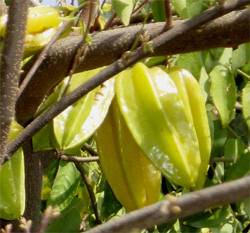
starfruit - carambola, balimbing
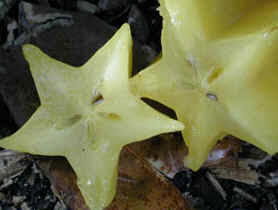
star apple - caimito (Chrysophyllum cainito)
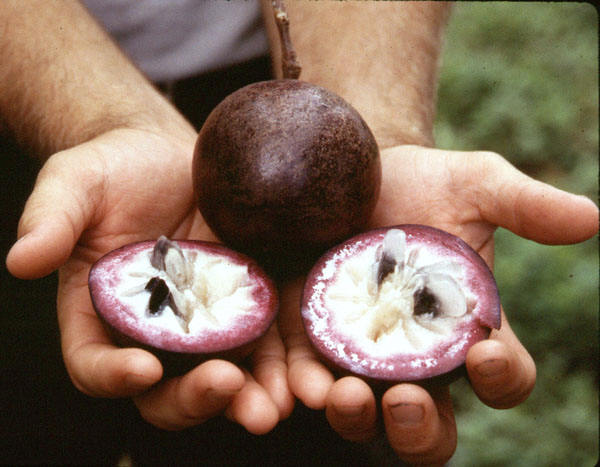
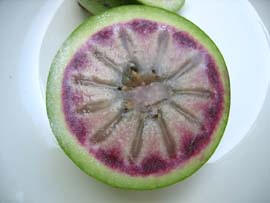
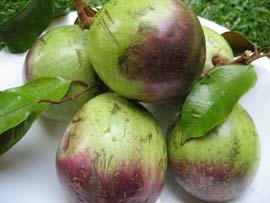
The caimito fruit has a star like design when it is sliced, hence its common name Star Apple. It is native of the West Indies and Central America. Caimito is not grown commercially on a large scale but is mostly appreciated as a fruit tree in home landscapes and along roadsides. A small commercial industry exits in south Florida. The leaves slightly leathery, shiny green on the upper surface and golden-brown on the lower surface. The fruits are delicious as a fresh dessert fruit; it is sweet and best served chilled. It has a soft, extremely sweet flesh that is delicious when cold. The peel may be red-purple, dark-purple, or pale-green. It is smooth, glossy, and leathery. In purple fruits, the inner rind is dark purple, and in green fruits, white. The pulp is white, soft, and milky surrounding 6 to 11 seeds. Generally the fruit is eaten fresh, although it may be an ingredient in fruit salads and sorbets.
tamarind - camachile, sampaloc (Tamarindus indica)
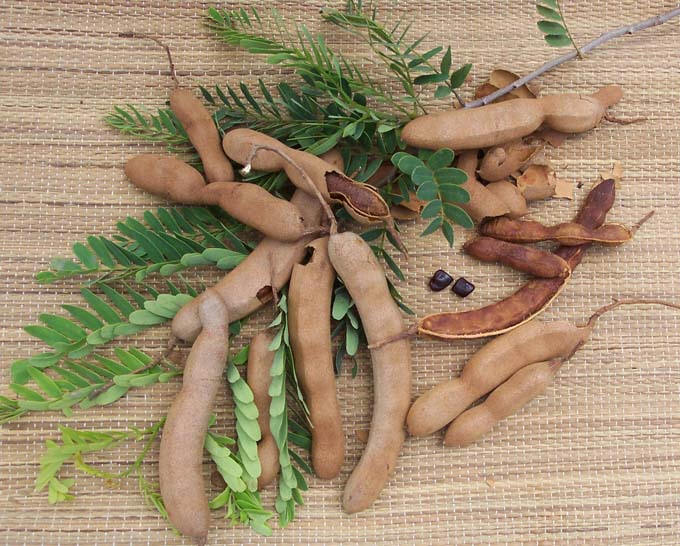
The tamarind is native to Africa and is well known in the tropics. The tree has long been naturalized in tropical America, the East Indies, the islands of the Pacific and South Florida. The tree grows and fruits best in a hot lowland tropical climate with distinct wet and dry seasons. It is grown as a shade and fruit tree, along roadsides and in dooryards and parks. It is appreciated because of its tolerance of drought, infertile soils, and strong winds. In Trinidad and Jamaica, tamarind is a popular refreshing snack. Asians, particularly in Thailand and India have a long tradition of eating and cooking with tamarind, creating delicious salsas, chutneys and sauces. The tamarind fruit "pod" is smooth, and brittle to the touch; inside the pasty flesh clings tightly to the hardened dark-brown seeds. The fruiting season in Florida is February to May and tamarind paste is available year-round in Asian specialty stores.
There is great variation in genetic characteristics of tamarind, but it has a limited germplasm base. Fairchild Tropical Botanic Garden has started a tamarind collection and selection based on productivity and fruit quality.
Camachile
(Pithecellobium dulce) is a common thorny tropical American tree that originated
from Mexico and other Central and South American countries where it is known as
Guamachil (an American Indian (Mayan not feather or dot) word that is the root
word for the local name Camachile). camachileIt was introduced to the
Philippines during the Spanish times and has spread throughout the Pacific
(Guam, Micronesia, Hawaii, etc.). It was also introduced to Thailand and onto
India where it is known as Manila Tamarind. A very common provincial tree, I
associate camachile with drives through Tarlac, Pampanga and Pangasinan in the
1970’s on the way to Baguio and the Mt. Provinces. The trees lined the highways
(if you could call the two lane roads that) and vendors used to sell the fruit
from right under the shade of the trees. Sometimes the fruit was packed in bags
that were hung from nails on the trunks of the hardy trees. I passed by these
same roads just last year during the summer and the same trees and lots of
vendors were still at it as they have been for the last 40+ years!
The camachile fruit or pods contain a white acidic and sweetish pulp that is
eaten raw. I was never a great fan of the fruit but I know others who are so I
took a picture of them at the market recently and decided to do this post. The
fruit is apparently devoured by livestock in other countries as well as by
humans. The bark, sap and fruit of the tree have several medicinal or astringent
uses which include treatments for venereal disease(!?), tanning leather hides
(!?) and making fish poison (!?) according to the Purdue University website on
different plant species and Doreen Fernandez’s book on Philippine Fruit. Talk
about varied uses! They are at the height of the season right now and are
abundant in the wet markets in Manila if you don’t happen to live near a fruit
bearing tree.
tambis
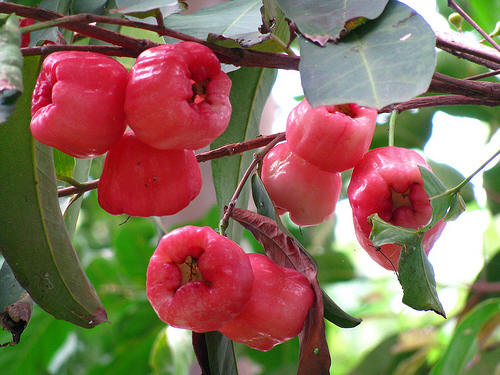
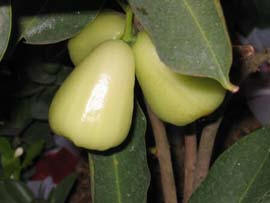
While the fruit is mostly eaten raw here in the Philippines (sometimes with rock salt), it is sometimes used for medicinal purposes in other countries or as a salve for the skin. In Puerto Rico, it is also made into a wine according to Desmond Tate’s book, Tropical Fruit of the Philippines… In this final photo, I spied a white makopa hybrid variety that was for sale at the market last weekend and the vendor said it was from Thailand. Marcotted and bearing fruit at just five feet in height, it was tempting to try and grow it in our small backyard… While there is some confusion over two very similar varieties (samarangense and malaccensis), makopa in other languages is known by the names malay apple, rose apple, java apple, curacao apple, pomme de java, etc. Here in the Philippines, Visayans know this fruit as tambis, while others call it tersana, yanba or yanbu.
Makopa and Makopang Kalabaw (Syzygium samarangense and Syzygium malaccensis) are reaching their peak just about now! Another sign that Summer is here (besides schools being on holiday, lighter traffic and a rising mercury) is the arrival of a brief but impressive explosion of makopa. Our neighbor across the street has a makopa tree that is groaning with fruit so I asked if I could take these photos. Makopa is one of those tropical summer fruits that don’t keep or travel well. Most of our childhood memories of eating makopa probably meant we lived near a source, usually a tree in the backyard or neighborhood.
The makopa tree is part of the myrtle or eucalyptus family. The fruit is bell shaped with a waxy skin and comes in pink, white, green and purple. It has a crisp, light (airy or spongy) white pulp that is mild in flavor. I hadn’t tasted makopa for nearly twenty years when during a business trip to Indonesia I noticed one of the office workers eating an intriguing afternoon snack of chopped makopa, green mango, snake fruit, pineapple and other fruits tossed with a chilli and dried shrimp sauce/paste - yum! Makopa is native to the Malay archipelago and it is believed to have been introduced to the Philippines in prehistoric times according to Doreen Fernandezin her book Fruits of the Philippines, who writes that makopa and tambis are interchangeable terms for the same fruit. There appear to be two main types of makopa in the country, I presume one being the smaller variety and the other being the larger variety, hence the addition to Kalabaw (Water Buffalo) to the name of the latter. The tree has now spread to Indonesia, the South Pacific Islands, Hawaii, India, the West Indies and even South America.
watermelon
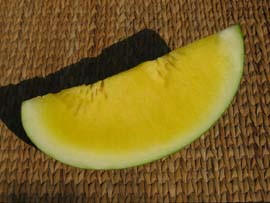
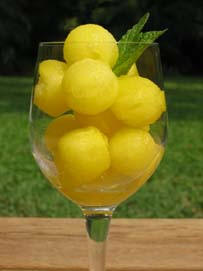 yellow watermelon
Another harbinger of Summer is watermelon… At the supermarkets over the weekend there were these seedless yellow watermelons that were superb. yellowPerhaps I just got lucky but the one I purchased was absolutely sweet, flavorful and delicious. Also referred to as Golden watermelons, they are typically described as having a less intense flavor than a good red watermelon but I found this particular specimen to be just as good as the reds I have eaten recently. At P40 a kilo, it was somewhat pricey - a large watermelon cost P210 - and could be divided into 12 generous slices or roughly P17 per slice. Most adults and kids I know love eating watermelon.
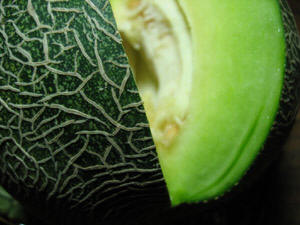
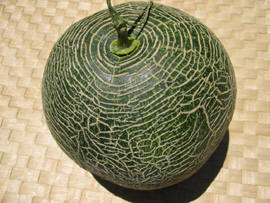 green melon
I saw this stunning green melon at the market last Saturday (along with lots of other melons and cantaloupes that are nearing the peak of melon season) and amel2the vendor said they were “Japanese” melons but grown here. I am always wary now when a vendor says something is Japanese as they are often totally clueless, see my post on Japanese tomatoes… I purchased one of these melons which looks very similar to those vaunted Cavaillon melons from France and took it home and placed it on my counter. Contrary to what most folks think, melons do NOT get riper once they have been cut from the vine. They might get juicier but they don’t get any sweeter so leaving them out to “ripen” really means you are simply waiting for them to get juicier… thus the best melons come directly from conscientious growers who harvest them at the peak of their ripeness. Sliced open, this melon was fragrant, juicy and sweet. Not the absolute best honey dew (as opposed to orange cantaloupe) I have ever had but a very good melon indeed. At PHP120 a kilo, this little baby cost PHP150 or so and would yield maybe 10 modest slices.
For the list of available fruit and nut trees, please check our Tropical Fruits page or click here. For the list of currently available fruit seeds, please email us.
|
|
|
|
|
|
|
Abiu |
Akee |
Anon |
Anon morado |
Acerola |
|
|
|
|
|
|
|
Bacuripari |
Bilimbi |
Biriba |
Borojó |
Cabelluda |
|
|
|
|
|
|
|
Cacao |
Caimito |
Carambola |
Cas |
Cherry of Rio Gde. |
|
|
|
|
|
|
|
Chupa-chupa |
Durian |
Flacurtia |
Grosella |
Grumichama |
|
|
|
|
|
|
|
Guayaba roja |
Jaboticaba |
Jakfruit, Jaca |
Jobo enano |
Litchi |
|
|
|
|
|
|
|
Loquat |
Madroño |
Mamey zapote |
Mangosteen |
Mangosteen |
|
|
|
|
|
|
|
Marang |
Níspero, zapodilla |
Ollita de mono |
Nuez Okari |
Pajui de amu |
|
|
|
|
|
|
|
Perita de agua |
Pitahaya |
Pitanga |
Peanut Butter Fruit |
Pulasan |
|
|
|
|
|
|
|
Quenepa |
Rambutan |
Tamarindo |
Tomatillo, curuba |
Uvaria |
|
|
|
|
|
|
|
|
Pili Nut |
|
Zapote negro |
|


.jpg)


